Galvanizing kettles built to survive the heat input, not just the pressure test.
Aluminium-killed low-silicon plate. Electroslag welded. Warm formed. From 2 t to 85 t, up to 16.5 m. Every structural weld ultrasonically tested — and your inspector is welcome to witness it.
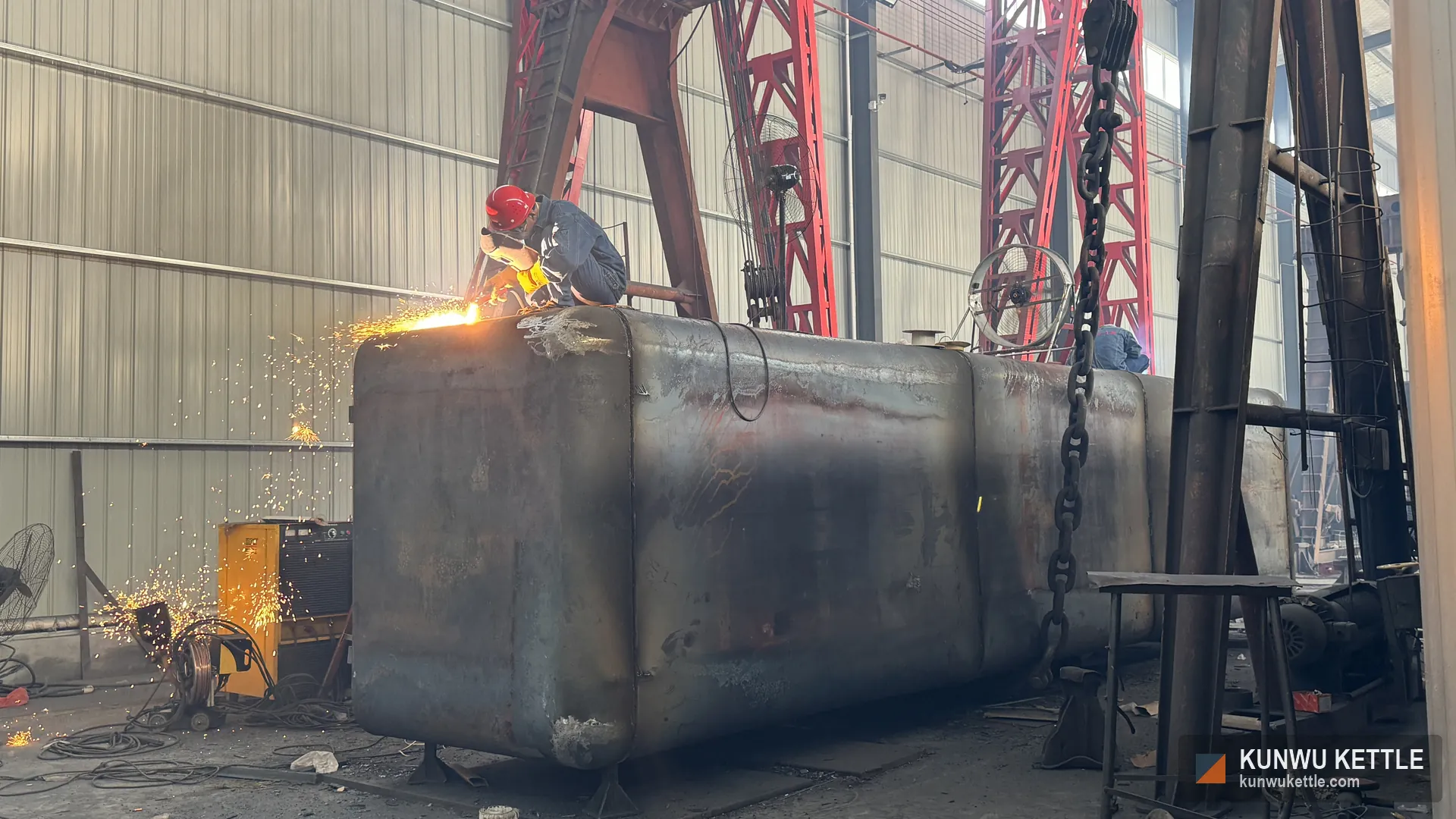
Your kettle is a countdown
Every galvanizing kettle is a consumable. Zinc dissolves iron, and from the day you fire it the wall is getting thinner. A well-built kettle in a well-run furnace loses 1.0 – 2.5 mm of wall per year. A badly built one, or a good one fired too fast on day one, can be through the wall in months.
So the question is never “is this kettle good”. The question is: how many years of production does this kettle buy me, and can the supplier prove it before I pay?
Most of what decides the answer is fixed before the kettle ever sees zinc — in the chemistry of the plate, in how the corners were formed, in the silicon content of the weld metal, and in the heat-up curve you follow on the first firing. Those four things are what this site is about.
What actually decides kettle life
Silicon, not strength
Silicon accelerates the dissolution of iron in molten zinc. Stainless and heat-resisting steels resist zinc worse than plain low-silicon structural steel — the opposite of what most people expect.
Read more →02The weld, not just the plate
Weld metal can carry thirty times the silicon of the parent plate depending on the consumable. That is why kettles go through at the seam while the wall is still thick.
Read more →03Stress you build in, or don't
All plate deformation done warm at 850–900 °C. Electroslag welding lays the full wall thickness in one pass, so heat input is uniform through the wall.
Read more →And then the first 48 hours. More kettles are shortened by a bad commissioning than by bad manufacturing. Room temperature to 300 °C at ≤ 2 °C/h. A 24-hour hold at 300–330 °C. Wall inside-to-outside differential kept under 50 °C throughout. We supply the curve with every kettle, and we will walk your team through it.
What ships with the kettle
Five documents, with every unit.
- Mill test certificate — EN 10204 Type 3.1Signed by an inspection representative independent of production at the mill.
- Welding consumable certificatesIncluding the low-silicon flux used to hold weld metal silicon to specification.
- Manufacturing inspection reportsDimensional check against drawing, fit-up records, weld visual, coating thickness.
- NDT reportsPlate inspection records and ultrasonic testing of every structural weld.
- Commissioning heat-up curveThe controlled firing schedule for your first heat. Most suppliers leave this out. It is also the one that decides whether the other four mattered.
Common questions
How long does a galvanizing kettle last?
Between three and ten years, depending far more on the furnace and the operating discipline than on the kettle itself. Under the operating rules in BG/T 1501-2015 — bath at 445–460 °C, inner wall below 480 °C, hourly throughput at 1/30 to 1/40 of the zinc volume — the corrosion rate stays at 1.0–2.5 mm per year. On a 50 mm wall, that is a long life. Break those rules and no kettle survives.
What steel do you use?
Aluminium-killed, low-silicon hot-rolled plate, specified by chemistry rather than by grade name. There is no equivalent EN or ASTM grade designation for kettle steel. Our specification is Si ≤ 0.03 %, P ≤ 0.02 %, Al ≤ 0.045 %, with the combined Si + P + Al held to ≤ 0.045 %.
What sizes can you build?
From 1.0 × 0.6 × 1.2 m up to 16.5 × 3.6 × 3.2 m, and from 2 t to 85 t per unit. Wall thickness 40, 50 or 60 mm.
Do you test the welds?
Every structural weld, ultrasonically, to GB/T 11345-2023 — which is identical (IDT) to ISO 17640:2018. Plate is ultrasonically inspected plate-by-plate before cutting. Reports are issued in English.
Who is responsible if something goes wrong?
Kunwu Kettle. We take full responsibility for the entire process — steel sourcing, welding, NDT, documentation and delivery. The kettles are built at our works in Hebei, China, which is open for your audit and pre-shipment inspection. You deal with one party from sizing through to the first heat, and that party is accountable for all of it.
Can we audit the plant before we order?
Yes. Factory visits and pre-shipment inspection are normal in this business and the works is open for both. Tell us when you are in the region, or send your own inspector — we will arrange access and provide the inspection and test plan in advance so your inspector knows what to look at.
Tell us the workpiece. We will size the bath.
We do not sell kettles from a catalogue. Send us the largest piece you need to dip and the throughput you need to hold, and we will come back with a sized kettle, a wall thickness, a zinc volume and a lead time.