Electroslag welding — full wall thickness in a single pass
ISO 4063 process 72. It is the process the most expensive kettle builders in the world use, and it is used for a specific reason.
What it does differently
Conventional multi-pass welding builds a thick joint in layers. Every layer is a separate thermal cycle, every interface between layers is a potential discontinuity, and the heat input into the surrounding plate varies from root to cap.
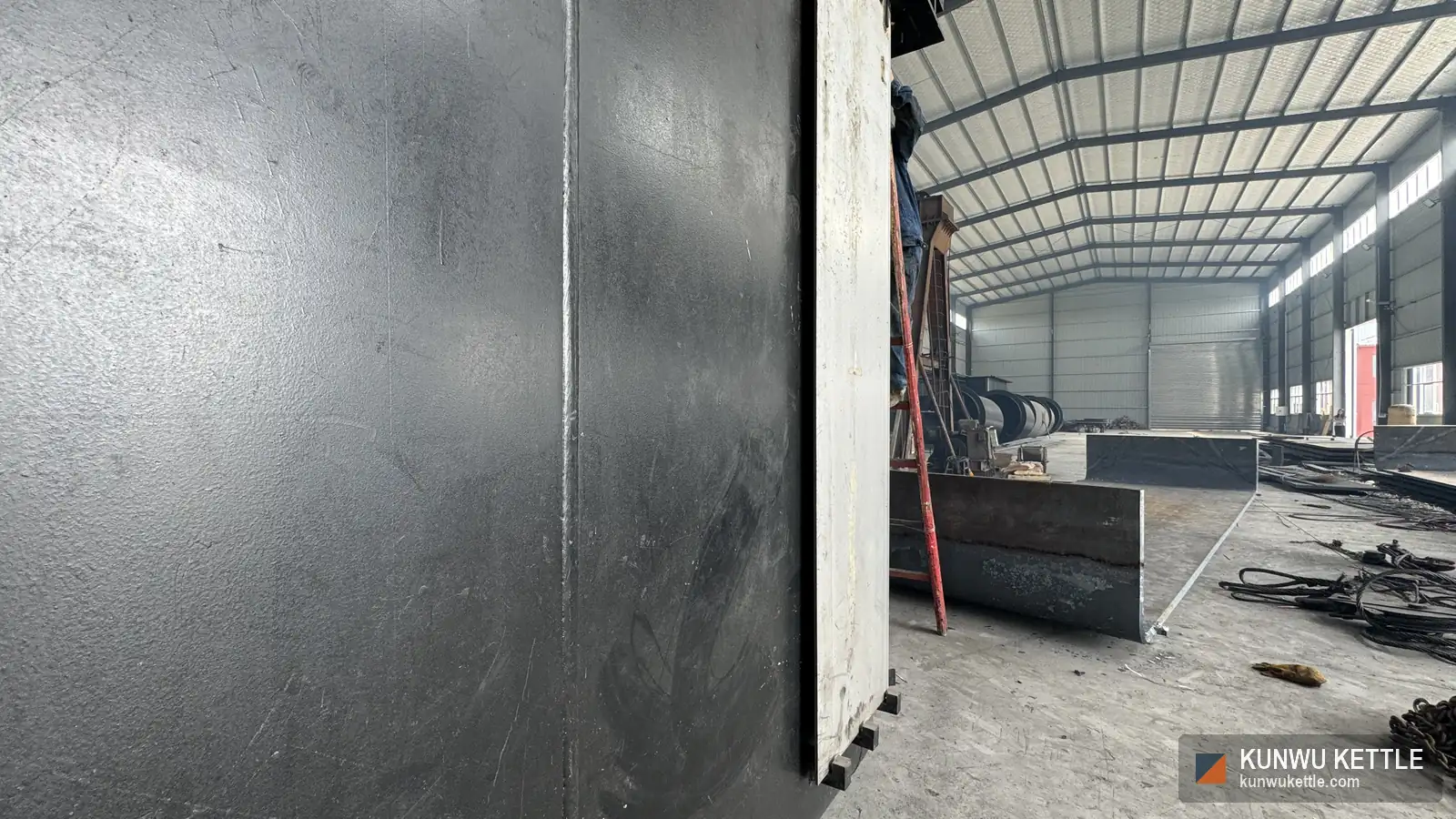
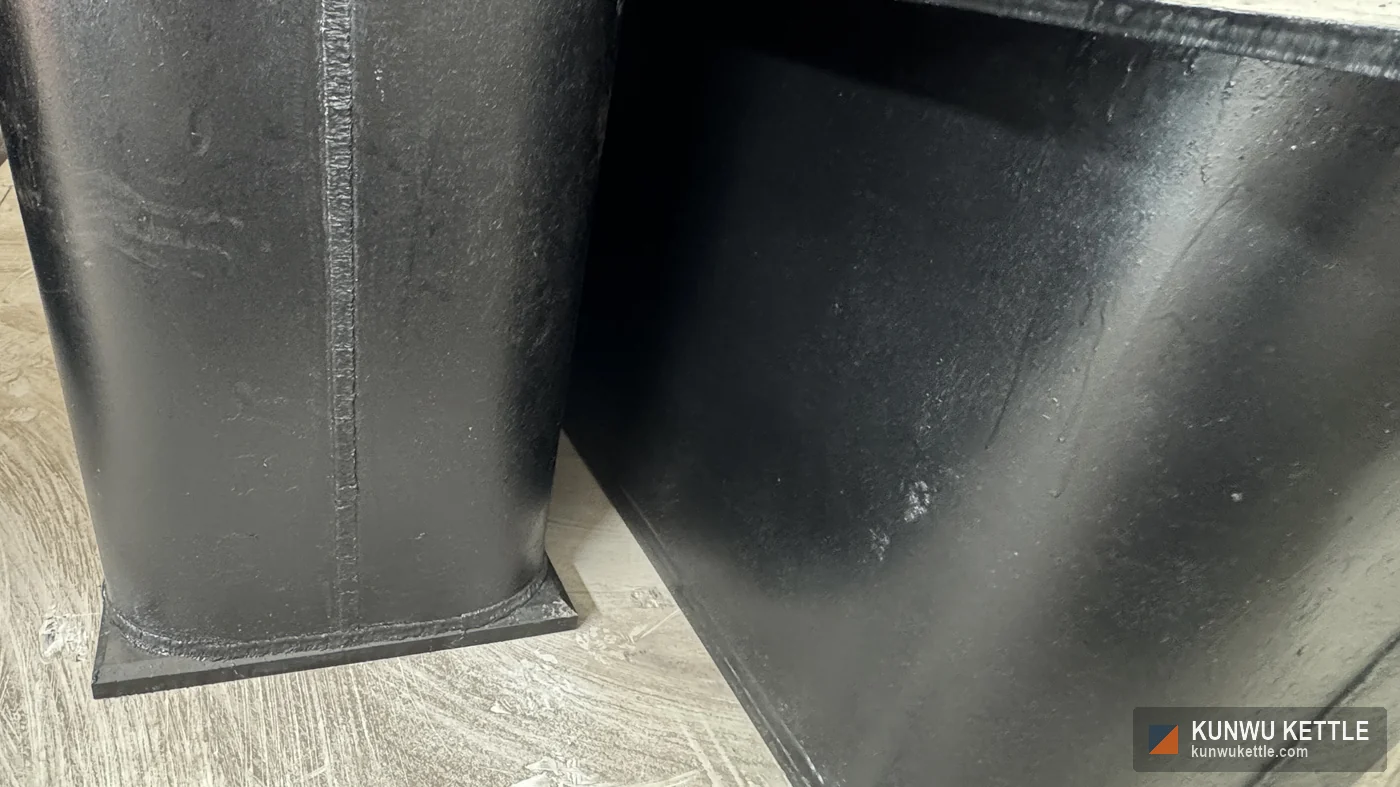
Electroslag welding fills the whole joint in one continuous pass, vertically, with the arc replaced by a resistively heated molten slag pool. On a 50 mm kettle wall that means one weld, one thermal cycle, no inter-pass interfaces, and heat input that is uniform through the full thickness.
| Parameter | Value |
|---|---|
| Process designation | ISO 4063 process 72 |
| Voltage | 40 – 50 V |
| Current | 300 – 1200 A |
| Single-electrode thickness range | 25 – 75 mm |
| Our kettle wall range | 40 / 50 / 60 mm |
The range above is the process window, not our settings. Actual voltage, current and travel speed come from the qualified welding procedure for your plate thickness and joint, and the procedure and welder qualification records are supplied with the order.
Combined with warm forming, and with joint design
ESW on its own is not the point. The point is total residual stress in a vessel that will spend its life at 450 °C.
- All plate deformation done warm, 850–900 °CNever cold.
- Full thickness welded in one passNo layered thermal cycling.
- Joint layout that avoids the worst locationsNo cruciform plate joints anywhere; parallel welds at least 0.5 m apart; and on full rounded corner kettles, no weld at the wall-to-base junction at all.
- Double-bevel joints welded alternately from both sidesBalances heat input and limits distortion.
What we control instead of impact toughness
We should be straight about a known characteristic of the process. Electroslag welding produces a coarse, columnar grain structure, because the weld pool cools slowly. In structural steelwork, that costs low-temperature impact toughness, and the textbook remedy is a normalising heat treatment.
A galvanizing kettle is a different service case.
| Structural steelwork | Galvanizing kettle | |
|---|---|---|
| Service temperature | Ambient or below | Constant ~450 °C |
| Loading | Dynamic, impact, fatigue | Hydrostatic and thermal, no impact |
| Is toughness the design driver? | Yes | No |
| Actual failure mode | Brittle fracture | Zinc dissolution and thermal stress cracking |
That is why BG/T 1501-2015 Table 10 specifies weld silicon content and NDT acceptance class for kettle welds — and specifies no impact energy requirement at all.
So the variables we control are the ones that decide kettle life:
- Weld metal Si ≤ 0.03 %, using low-silicon flux — Grade 1 of BG/T 1501-2015 Table 10
- 100 % ultrasonic testing of structural welds to GB/T 11345-2023 (identical to ISO 17640:2018)
- Back-gouging and grinding of the reverse side before the second pass, with penetrant testing where required
Why weld silicon gets its own specification. Weld metal is not the same steel as the plate. Submerged arc welding with standard flux can deposit metal with silicon several times the plate limit. When that happens, the weld dissolves faster than the plate around it — and the kettle goes through at the seam while the wall is still thick.
Nobody else publishes their weld silicon limit. It is the number we would want to see if we were buying. The full explanation is here.
Stress relief
Full stress-relief annealing at 600 – 650 °C, heating and cooling at ≤ 50 °C/h, held 2 – 4 hours, furnace-cooled below 300 °C.
Whether your kettle is annealed at the works is specified on the order. Ask for it and we will price it; occupying a furnace for the better part of a day has a real cost, and we would rather show you that cost than bury it or quietly skip the step.
Where a kettle ships without full annealing, the stress relief is completed during commissioning — which is precisely what the 24-hour hold at 300–330 °C in the heat-up curve is for. We supply that curve with every kettle.
Source: BG/T 1501-2015 — §5.2.4, §5.5, §5.6, Tables 5, 6, 10. ISO 4063 welding process designations.
See the inspection, not just the certificate
Every structural weld is ultrasonically tested, and your own inspector is welcome to witness it before the kettle ships.