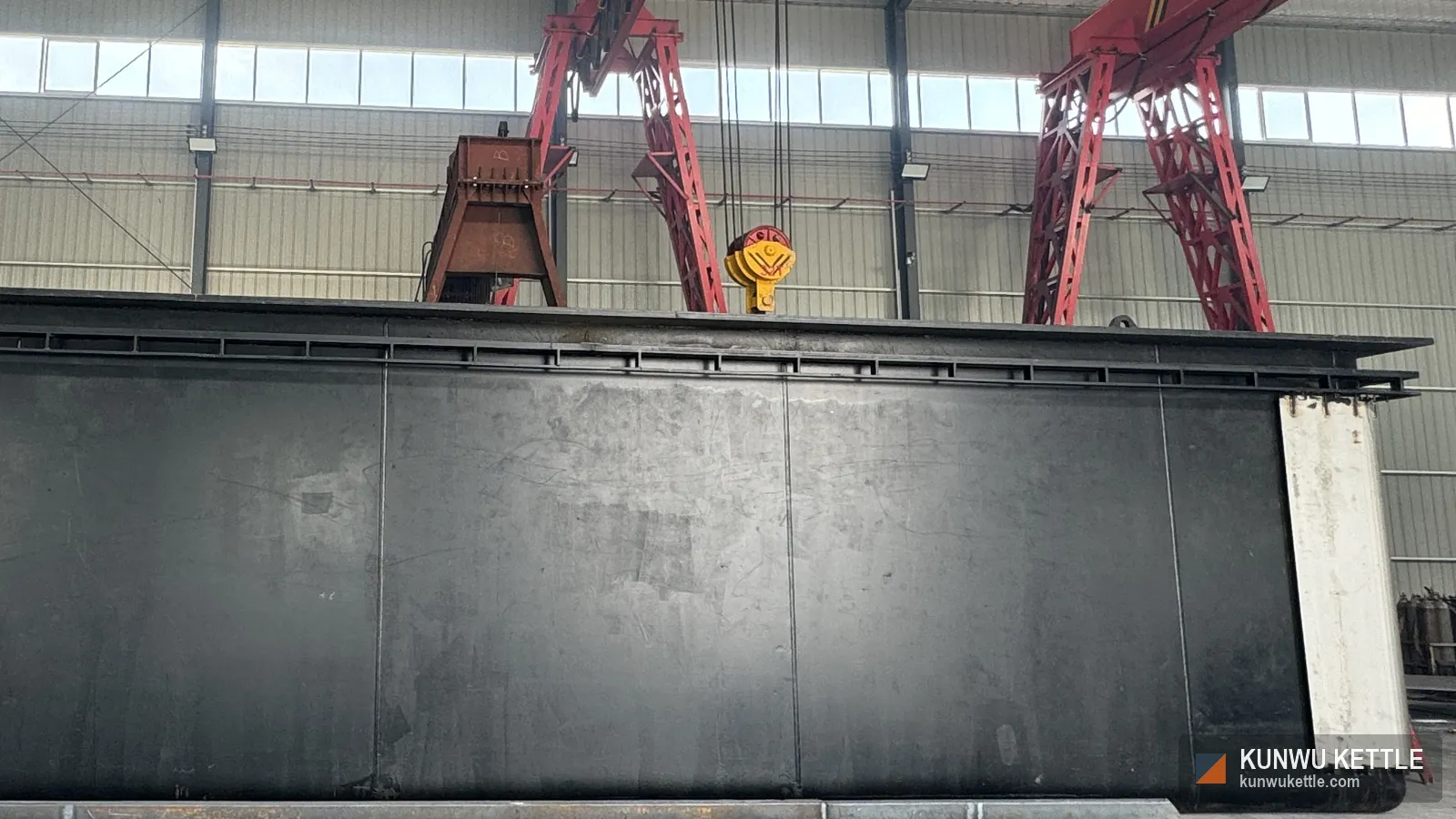
Full rounded corner galvanizing kettle — double flange
For baths deeper than 2 m, where hydrostatic load on the wall-to-base joint is highest and bottom dross has to be able to move.
Why a full radius below 2 m of depth
At depth, two things go wrong with a square wall-to-base joint. The weld sits exactly where hydrostatic pressure is highest, and the internal corner becomes a dead zone where bottom dross accumulates and forms an insulating layer — which drives local overheating on the outside of that same corner.
Radiusing the junction removes both. There is no weld at the point of highest load, and dross has nowhere to sit still.
The internal bend radius is 125–200 mm, formed warm at a radius of at least 2.5× plate thickness, with wall thinning held to under 5 % of plate thickness.
Why double flange
Two flanges give the furnace a wider bearing surface and a stiffer top edge, which matters on long kettles where the top edge is the least supported part of the vessel.
If your furnace is built for a single flange, we build single. It is not a quality difference, it is an interface difference.
Specification
| Metric | Imperial | |
|---|---|---|
| Length | up to 16.5 m | up to 54 ft |
| Width | up to 3.6 m | up to 11.8 ft |
| Depth | over 2.0 m, up to 3.2 m | over 6.6 ft, up to 10.5 ft |
| Wall thickness | 50 / 60 mm | 2.0 / 2.4 in |
| Corner radius | 125 – 200 mm | 4.9 – 7.9 in |
| Weight | up to 85 t | up to 94 short tons |
| Design standard | BG/T 1501-2015 |
Support note. Above 1.8 m depth the kettle needs one adjustable external support band; above 2.5 m, two. Support points at 1.5–2.0 m intervals, and expansion clearance along the length. Any part of the support inside the furnace hot zone must be heat-resisting steel. We specify this with the kettle.
Sizing this kettle for your plant
Three inputs decide it.
- Your largest workpieceSets minimum length and width, with clearance to dip, withdraw and skim.
- Your required throughputZinc volume should be 30–40× your maximum hourly throughput including jigs, so the bath temperature holds.
- DepthNormally 1.3–2× the width. Going deeper increases thermal mass, reduces temperature swing, lowers heat input density per m² of wall, and helps dross settle away from the work.
What every kettle gets
- Aluminium-killed low-silicon plate, Si ≤ 0.03 %Ultrasonically inspected plate-by-plate to GB/T 2970 Class III before cutting.
- All forming done warm, 850 – 900 °CCold bending locks residual stress into a vessel that will run at 450 °C for years.
- Electroslag welding, ISO 4063 process 72Full wall thickness in a single pass. No inter-pass interfaces.
- Weld metal specified to Si ≤ 0.03 %Grade 1 of BG/T 1501-2015 Table 10. Weld silicon decides where a kettle goes through first, so it is written into the order and evidenced by the welding consumable certificates that ship with the kettle.
- Ultrasonic testing of structural welds before dispatchGB/T 11345-2023 — identical (IDT) to ISO 17640:2018. Coverage and acceptance level are agreed with you and recorded in the inspection and test plan. Reports in English.
- No cruciform plate jointsParallel welds kept at least 0.5 m apart, per BG/T 1501-2015 §5.2.4.
- Full documentation packageIncluding the commissioning heat-up curve for your first firing.
Questions
Can you build this deeper than 3 m?
Yes, up to 3.2 m. Above 3 m depth we would normally specify 60 mm wall rather than 50 mm.
How long is the lead time?
It runs from confirmed drawings, not from your enquiry, and it depends on size and on what is already on the shop floor. We quote a date with the price, and we would rather quote a date we can hold than the shortest one that wins the enquiry. If you have a fixed outage window, tell us the date you need the kettle on site and we will tell you whether it is achievable before you place the order.
How is a kettle this size shipped?
Anything over about 12 m will not fit a standard container and moves on flat rack or as breakbulk. We arrange it — and we will tell you what your site needs to lift it off the truck before you order, not after.
Can you match our existing furnace?
Yes. Send the furnace opening dimensions, the support arrangement and how it is heated. Where a replacement has to drop into an existing furnace, the interface matters more than the catalogue.
Send three numbers, get a sized quote
Largest workpiece, required throughput, and how your furnace is heated. That is enough for us to come back with a sized kettle, a wall thickness, a zinc volume, a weight and a lead time.